Questions
How
do I increase stride length here
How
to run a faster 40 here
What
is the VALSALVA MANEUVER here
What
are ins and outs here
Do the combines predict success of the football
field,
new research says yes here
How should
endurance athletes improve endurance here
Why you
don't want to use steroids - here
Sample Track & Field workouts here
Why is proprioception so important here
How do I treat hamstring injuries here
How to start from blocks here
|
How
Important is speed in soccer?
Strength and speed characteristics of elite, subelite,
and recreational young soccer player
Sports
Med. 2006 Jul-Sep;14 (3):205-14. Gissis
I, Papadopoulos C, Kalapotharakos VI,
Sotiropoulos A, Komsis G, Manolopoulos E.
The
purpose of the present study was to compare maximal isometric
force, force-time curve characteristics, pedaling rate, vertical
jump, and sprint performance among young soccer players from
different competition levels. All groups were evaluated for
maximal isometric force, explosive force at 100 msec, peak
force relative to body mass, rate of force development, squat
and drop jump heights, 10 m sprint time, and pedaling rate.
The elite group presented significantly (p < 0.05) higher
maximal isometric force, vertical jump height, and pedaling
rate, and lower 10 meter sprint time in comparison with the
subelite and recreational groups. No significant differences
were observed in strength and speed characteristics between
the subelite and recreational young soccer players.
The
findings of the present study suggest that the elite young
soccer players can be distinguished from subelite and recreational
young soccer players in strength and speed characteristics.
These strength and speed measures can be used for strength
and speed diagnosis, and for designing and evaluating training
programs. PMID:
16967772
|
|
Phil
Campbell offers a free fitness improvement newsletter at: www.readysetgofitness.com
"Great
newsletter!! Another reason why people who have exercised hard (anaerobically)
since their 20's or 30's look much younger in their 40's - 60's!
Also, those that start this type of exercise later in life make
themselves look and feel younger than their peers that do not exercise.
Keep sending these great newsletters!!" - Dr. Michael Hartle,
Chairman, USA Powerlifting Sports Medicine Committee
How do I increase the length of my stride?
Several
factors involved. First, Body composition - The less lean,
the shorter stride length.
Strength
and Power - Maximum strength contributes to joint stabilization
at high velocities which aids in elastic strength expression.
Elasticity
(Flexibility in motion) - Recently, a researcher found in a drop jump
that muscle actually shortened a small amount as the whole system
lengthened. This implies that connective tissue is the elastic part
of the system. This means that max strength is even more important.
The muscle is almost static so ATP is not required. Thus the energy
cost in elastic force production is very low.
The
elastic component supports the contractile component for force production
and when utilized, contributes to much longer stride lengths. The
ability to anticipate the need for force production is important in
elastic force production
Neuromuscular
Sequencing - The specific sequential firing order of the muscles
involved is essential. The anticipation of the forthcoming action
and the sending of the proper message to the brain to fire the muscles.
Dynamic
Mobility - The ability to move a limb segment through a greater
range of motion in the same time or a prescribed range in a shorter
time.
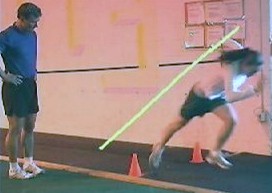
THE
LENGTH-FREQUENCY RELATIONSHIP
Stride
Frequency is the larger limiting factor in speed performance. Researcher
Mann points out that most better sprinters improve their performance
through improved stride rate.
Both
Length and Frequency are improved by increasing leg strength which
results in necessary ground force production more quickly.
Conclusion:
Stride length can be limited by lack of flexibility and leg strength.
Ross
Dunton, DUNTON SPORTS MANAGEMENT has full discussions about this topic
on-line at www.coachr.org
How can I run 40 yards faster?
Speed for Sports uses the following Pro-combine sprint performance
improvement model. Average gains in the 40 during one training session
a week for four weeks (with four 10-minute stretching homework assignments)
is .5 seconds.

Two
acceleration points
in the 40.
At the blast-out "combine start" and first entering the fly
phase at the 20 yard point
"ins
& outs" drill teaches:
- acceleration
technique
- mental focus
& preparation
- power lean
technique
- VALSALVA
breathing
- power arm action
- hands
move pocket to chin slightly toward the center to maximize hip
rotation.
Speed Camp
Registration Form download here
10-Minute
Stretching Routine
1.
Hamstring Stretch
2. Torso Twist
3. Hamstring Leg Raise Stretch
4. Split-leg Stretch
5. Achilles/Calf Stretch
Phil Campbell highly recommends the Dave Ellis Fueling Tactics Sports
Nutrition System at
Fuelingtactics®
-
teaching strategies to help athletes outwork the competition.
What are
"INS & OUTS"
"Ins
and Outs" is a fundamental speed development drill that teaches acceleration
and breathing skills necessary for optimal speed.
Drill description;
mark a course 40 yds long and divide into equal 10 yd segments.
Each "In"
is an acceleration push that is followed by an "out," which
is relaxing (while running fast), taking some sips of air, and coasting
off the previous acceleration push.
IN =
With a standing start, stride to the first mark. When the athlete hits
the 10 yd mark, with maximum acceleration, exert maximum force and speed
while holding the breath through the first "in phase".
OUT =
After the "in," slightly coast (relax while running fast) and
breathe while maintaining speed through "out" section. Once
the athlete hits the next mark (acceleration POINT), this is followed
by another "in" acceleration push.
 |
I
have read every book on training for triathlons, but it was
not until I started doing this program that I started to reach my
full potential as an age-group triathlete.
- Dr. Tim Berry, Family Physician and triathlete
Dr. Tim Berry,
family physician, and Dr. Debra Berry, pediatrician, after a triathlon
|
"I
am primarily
a distance runner and I want to run the Boston Marathon, but I have not
made the qualifying time. The sprint workouts have helped my distance
speed. I was surprised that it took only a few workouts
to see a difference. I am convinced that I will have a qualifying
time for the Boston Marathon. My quads got very fatigued during my last
marathon, and I believe the added strength and running speed resulting
from the sprint workouts will take care of that problem."
- Joe Judkins, President, Oak Ridge Running Club
Use the "VALSALVA MANEUVER" at Acceleration points
When the
breath is held, certain physiological changes automatically position the
body for enhanced speed. This is called the "Valsalva Maneuver."
It is created by holding the breath briefly during acceleration.
The body
goes into the fight or flight mode and there is an increase in blood pressure
in the carotid artery. Chest cavity and abdominal pressure are increased.
The body's sensors are turned on improving the athletes awareness. Holding
the breath briefly provides many advantages to the athlete when exploding
to avoid a tackle, steal second, beat an opponent to the hoop, or get
to the soccer ball first.
Physical Characteristics That Predict Functional Performance in Division
I College Football Players
Davis, 2004,
Journal of Strength and Conditioning Research: Vol. 18, No. 1, pp. 115120-
Strength and conditioning
professionals who work with collegiate football players focus much of
their time and effort on developing programs to enhance athletic performance.
Although there has been much speculation, there is little scientific evidence
to suggest which combination of physical characteristics best predicts
athletic performance in this population. The purpose of this investigation
was to examine the relationship among 6 physical characteristics and 3
functional measures in college football players. Data were gathered on
46 NCAA Division I college football players. The 3 response variables
were 36.6-m sprint, 18.3-m shuttle run, and vertical jump. The 6 regressor
variables were height, weight, percentage of body fat, hamstring length,
bench press, and hang clean. A stepwise multiple regression analysis was
performed to screen for variables that predict physical performance. Regression
analysis revealed clear prediction models for the 36.6-m (40 yards)
sprint and 18.3-m shuttle run. The results of this investigation
will help strength and conditioning specialists better understand the
variables that predict athletic performance in Division I college football
players.
Training Tip for Distance Runners
By George Payan (From Ross Dunton's Newsletter)
What
I observed in runners I trained was the jump from 6 to 7 miles a day,
produced the biggest jump in fitness level and the largest drop in racing
times. After achieving and sustaining 7 miles a day, the gains above (8
or 9, for instance) were not as pronounced. My suspicion is that somewhere
between 6 and 7 miles per day, there is a threshold achieved that maximizes
the benefit to oxygen uptake.
How
should endurance athletes improve endurance?
New research
study reports how.
A study was
conducted to investigate the effects of short-term, high-intensity sprint
training on the performance of trained cyclists when performed with endurance
training. Seventeen trained cyclists were randomly assigned to a sprint
training. Sprint training was performed biweekly for four weeks, comprising
a total of 28 min over the training period.
In conclusion,
these data suggest that four weeks of high-intensity sprint training combined
with endurance training in a trained cycling population increased motor
unit activation, exercising plasma lactate levels, and total work output
with a relatively low volume of sprint exercise compared to endurance
training alone.
("Neural, Metabolic, and Performance Adaptations
to Four Weeks of High Intensity Sprint-Interval Training in Trained Cyclists,"
2004, Creer, International Journal of Sports Medicine; 92-98)
How
do you treat hamstring injuries, click here.
Starting from Blocks
by
Ross Dunton, Dunton Sports Management
email: coachr880@bellsouth.net
THE
BLOCK START
1) Used to put the
sprinter in a better position to accelerate
a) Determine quick side for placement of foot in back block
b) Determine block position
(1) 2 foot lengths from line to front block and another foot length between
front and rear block
(2) .55 x leg length for front block distance and .42 x leg length for
distance between blocks
(3) Distance from tibial tubercle to the toe when foot is in complete
plantar flexion - front block, 1-1 V2 foot lengths for distance between
blocks
c) Psycho-Physiological preparation preceding entering of blocks
(1) Pre-setting the neuromuscular system by preparatory movements
(a) Explosive vertical jumps
(b) 4-5 practice starts (research supports fact that the 5th -6th effort
comes closest to maximal)
(c) Use of a motor set rather than a sensory set to reduce reaction time
"On
your marks"
(1) Toes or ball
of foot in contact with the track and firmly against the pedals of the
block
(2) Arms with thumbs directly under shoulders and equidistant from the
saggital mid-line of the body
(a) Maximizes distance of shoulders from the ground
(b) Keeps weight distributed evenly so as to not overload on the quick
side
(3) Fingers and hands form a high bridge thus increasing shoulder to ground
distance
(4) Shoulders directly over hands (saggital view) to eliminate hip movement
forward and upward on set command
(5) Quick side
(rear) knee in contact with the ground (both knees down puts shoulders
ahead of hands and increases strength demand as well as introducing imbalance)
(6) Head aligned so neck and back of head become linear extension of the
spine
"Set"
(1) Power side (front)
knee is approximately 90 degrees
(2) Angles less than 90 correlate with low power production
(3) Muscle tension applying force against the block
(4) Quick side (rear) knee is approximately 120 degrees
(a) Highly efficient angle for knee extension
(b) Force application should come from gluts and hamstrings - pretension
desired
(c) Pretension of the involved muscles minimizes movement time and eliminates
a conscious pushing with the rear leg at the gun
(5) Shoulders above the hands
(a) Position depends on sprinter's arm/shoulder strength
(b) Deviation forward or back will effect the distance between the front
ankle and the hip as measured along the track surface
i) Effects force application and therefore acceleration
(6) Hips above the shoulders
(a) Manipulation of this variable will affect angles' at the knee and
hip, as well as ankle to hip distance
(7) Shins parallel and at a low angle with ankle behind knee
(a) The angle of the front shin should determine the body's projection
angle in the first step
(8) The horizontal distance between the ankle and the hip is probably
the most critical factor to evaluate
(a) Within limits, the greater this distance, the potentially more efficient
will be the acceleration
(b) Within limits, the greater this distance, the shorter must be the
ground contact time and the time to apply force
(c) When this distance is small, the ability to apply force to overcome
the body's inertia is poor.
(9) Cue a motor set to focus upon
(a) A motor
set means to have the athlete focus upon their first movement, not the
gun
"Go"
(1) Extension of
the quick side arm to contribute to force production on the power leg
(a) Press-pressure on the rear block
(b) Push-pressure on the front block
(2) Power side arm moves virtually simultaneously with quick side arm
(3) Work to extend both thighs at the hip simultaneously to propel C of
M forward
(a) Force must come from gluts and hamstrings to create hip extension
(b) Quadriceps extension is timed so as to leave the shin angle unchanged
and thus contribute to movement of the C of M forward
i) Keep C of M moving in same path initiated by gluts and hamstrings forward
and slightly upward
(4) Once the quick side leg has reached optimal extension, it is recovered
(a) Thigh flexed at hip
(b) Small degree of flexion at knee
i) Only flexed to degree necessary to keep shin angle just slightly greater
than the previous contact
ii) Heel to butt usually results in too large a shin angle on the next
contact resulting in poor force application for acceleration
(c) Foot dorsiflexion
i) Places the ankle joint in a mechanically advantageous position for
the next ground contact
ii) Pre-sets muscles used in plantar and dorsiflexion to create a rigid
ankle for elastic force production essential for short ground contact
time required by the horizontal distance between ankle and hip
(d) If recovery comes too late:
i) Range of motion of the swinging thigh will be shortened resulting in
loss of negative foot speed on ground contact in the next step
ii) OR greater vertical forces will be generated to allow time for the
thigh to complete the full range allowing movement to be complete but
sacrifices stride frequency
(e) If recovery is too soon, the amount of force applied to the block
is much less than optimal
(f) The thigh should be abruptly decelerated at the time of optimal extension
of the hip and knee of the power side
Departure
(1) Even in the first
flight phase the athlete should be airborne, not walking from the blocks
(2) Each successive stride is a modification of the previous stride
(a) Changes that occur as a result of increasing velocities and decreasing
acceleration values
i) Ankle-hip distance is progressively reduced
ii) Shin angles increase
iii) The importance of generating negative foot speed increases
iv) Backside mechanics give way gradually in importance to frontside mechanics
v) The pattern of foot placement increases in regular progression with
each step longer than the previous.
(The initial increment is 10-20 centimeters and increases with acceleration)
i) Ground contact time decreases
Why you don't want to use steroids
An Athlete's Dangerous Experiment
By
Jere Longman, The New York Times
PLANO, Tex., Nov.
25 After recording one save last season, Taylor Hooton expected
to join the starting rotation next spring for the baseball team at Plano
West Senior High School.
"You could count
on the kid to throw strikes," said Billy Ajello, Taylor's best friend
and a catcher at Plano West, which is located amid the affluent sprawl
north of Dallas.
By all accounts, Taylor
was popular and ebullient. He was a cousin of Burt Hooton, the former
major league pitcher, and his brother pitched in college. Next spring,
he would make his own mark during his senior season. But on July 15, a
month past his 17th birthday, Taylor Hooton killed himself. The authorities
ruled the death a suicide by hanging.
His parents and a
doctor familiar with the case said they believe that Taylor's death was
related to depression that he felt upon discontinuing the use of anabolic
steroids. The sense of euphoria and aggression that accompany the use
of steroids can be replaced by lethargy, loss of confidence, melancholy
and hopelessness when a person stops using performance-enhancing drugs,
doctors said.
"It's a pretty
strong case that he was withdrawing from steroids and his suicide was
directly related to that," said Dr. Larry W. Gibbons, president and
medical director of the Cooper Aerobics Center, a leading preventive medicine
clinic in Dallas. "This is a kid who was well liked, had a lot good
friends, no serious emotional problems. He had a bright future."
Taylor Hooton's example
is extreme, but the use of steroids by athletes and nonathletes in high
school is considered even more troubling than the use of them by elite
athletes who are involved in widely publicized scandals in sports like
football, baseball and track and field, a number of doctors said.
While there are relatively
few professional athletes, some doctors estimate that 500,000 to one million
high school students, or more, use steroids. Adolescents are also more
susceptible to some physiological dangers, including premature cessation
of bone growth, which can limit a person's height, doctors said.
By nature, teenagers
are risk takers, and they are less likely to understand the health risks
or to be concerned with potential side effects like infertility, atrophied
testicles, high blood pressure, liver damage and prostate cancer, some
of which may not appear for 20 or 30 years, doctors said.
Anabolic Steroids May Lead to Violence
BOSTON (UPI) -- Anabolic
steroids may have long-term effects on players' behavior and aggression
long after they stop abusing the performance enhancing drugs. Northeastern
University psychology professor Richard Melloni, with funding from the
National Institutes of Health, recently found evidence that long after
steroid use ends it can produce long-term aggression, the university said
Friday. Melloni has been studying how steroids used during adolescence
may permanently alter the brain's ability to produce serotonin. Adolescent
Syrian hamsters, given their similar brain circuitry to human adolescents,
were administered doses of anabolic steroids and then measured for aggressiveness
over certain periods of time.
The researchers initially
hypothesized steroid use during adolescence might permanently alter
the brain's chemistry and a person's tendency toward aggression long
after use has stopped. Their most recent findings, published this week
in Hormones and Behavior, enabled them to confirm this hypothesis and
conclude there is indeed a lengthy price -- namely long-term aggression
-- to pay for drug abuse even after the ingestion of steroids ceases.
"We know testosterone or steroids affect the development of serotonin
nerve cells, which, in turn, decreases serotonin availability in the brain,"
Melloni says.
Study
Summary
KINEMATIC DETERMINANTS OF EARLY ACCELERATION IN FIELD SPORT ATHLETES
(Murphy,
2003, Journal of Sports Science and Medicine 2, 144-150)
Acceleration performance
is important for athletes that need repeat sprint ability. Although acceleration
is widely trained for, there is little evidence outlining the key factors.
The aim of this study was to determine the kinematic differences between
individuals with fast and slow acceleration.
Twenty athletes were
tested and filmed for sprint ability over the first three steps of a 15m
sprint and classified as fast or slow.
Results: The fast
group had significantly lower (11-13%) left and right foot contact times,
increased stride frequency and better knee extension. There was no
difference found in stride length.
Conclusion: Athletes
who are naturally fast in early acceleration achieve this through "reduced
ground contact times resulting in an improved stride frequency."
Training for improved acceleration should be directed towards using coaching
instructions and drills that specifically train such movement adaptations.
What is proprioception? This is a physical therapy rehab term used
to describe the awareness of how the position of a joint. Someone recovering
from knee replacement surgery has to build back the muscle around the
knee and build back the middle-ear balance from not using the knee for
a few weeks. Technically, proprioception (pro'pre-sep'shn) is the feeling
linked to cues from within the body. The cues help one to know the positions
of body parts and the motions of the muscles and joints
(Mosby's
Medical Encyclopedia).
Propriception has
a sports training application. Nerve endings in muscle and tendons are
constantly sending and receiving signals to and from the brain that determine
when and how far to activate muscle fiber. If an athlete injures an ankle,
not only does the athlete need to rehabilitate the ankles, but also the
proprioceptors, so the balance with the joint comes into play.
When learning the
acceleration position, which is a hard learn forward from the ankles,
it require time and conditioning of the middle-ear, nerve endings in the
body, and the central nervous system (proprioceptors) to give the athlete
a since of balance.
For
more information about Soccer Speed Camp
Check
for openings, call Kathy (everyone's best friend)
at toll free (866) 565-3311
|